

Why More Caterers and Hotels Are Outsourcing Their Pastry Programs
Running a pastry program inside your own kitchen looks simple from the outside: hire a pastry chef, buy some equipment, put desserts on the menu. In practice it is one of the more fragile parts of a kitchen. It depends on one or two specialized hires, it is sensitive to turnover, and it is expensive to keep consistent across a full season of events.
That is why more caterers, hotels and restaurants are asking a different question: not "can we make this ourselves?" but "should we?" This guide covers the pressures behind outsourcing pastry, how to run the numbers honestly, what a wholesale partner should offer, and how to start.
A Growing Market for Outsourced Baking
The shift is visible in the market. Market Intelo estimates the global bakery contract manufacturing market at $28.5 billion in 2025, growing to $41.7 billion by 2034, a compound annual growth rate of 4.1%. That is a broad category covering many types of baked goods, not only fine pastry, but it shows how normal it has become for food businesses to hand production to specialists.
The Pressure on In House Pastry
Staffing is the biggest reason. The National Restaurant Association reported in December 2025 that 70% of operators struggle to fill open positions and 45% do not have enough staff to meet existing customer demand. Toast puts annual turnover in the industry at around 73.9%. The industry is adding jobs, but the pressure has not gone away. Wages for production and nonsupervisory restaurant workers have risen from $13.36 an hour in April 2020 to $19.68, according to figures collected by Bite.
A pastry chef is one of the harder roles to staff reliably. Training a replacement partway through a season can quietly hurt the consistency of a dessert menu for months. Add the cost of specialized equipment, ingredient waste from small batch production, and the opportunity cost of kitchen space that could go to the savory side of the menu, and "just hire a pastry chef" starts to look like the expensive option.
For hotels and venues the math can be even harder. Pastry demand is seasonal and event driven, so a full time hire is either underused for part of the year or the operation is short staffed at peak.
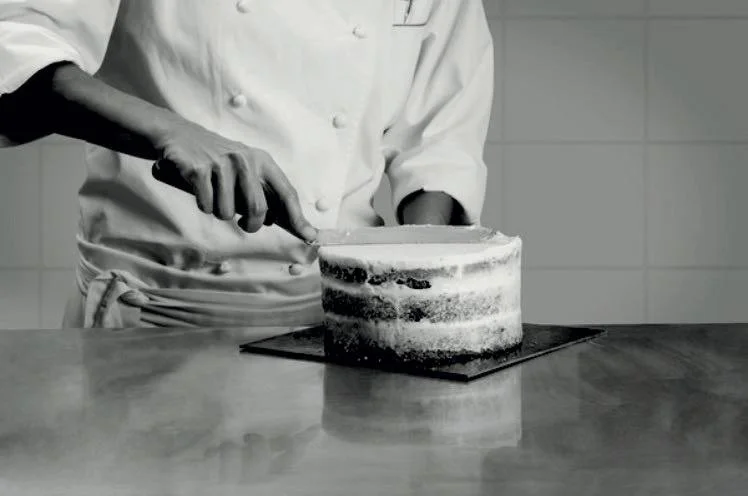
Skilled pastry work takes time and training, and is hard to staff in house.
Time, Labor and Space
Pizza Today puts the decision into three words: time, labor and space, the things many operations find "sorely lacking." Its advice on whether to outsource desserts is practical: run the numbers, establish your true cost per dessert, and test before you commit. It also notes that outsourcing desserts is a normal option, and that many operators use a mix of in house and outsourced items.
Demand for dessert itself is not in doubt. The same article cites Datassential finding that 60% of operators say their desserts help drive profit. The question is who should make them.
What Outsourcing Actually Looks Like
The alternative is not a lower quality shortcut. It is shifting production to a specialized partner who already runs pastry at scale. Curty's USA crafts its hors d'oeuvres and petits fours by hand in Paris. They are flash frozen and vacuum sealed the same day, then stocked here in the USA, so product arrives finished and ready to serve.
For a caterer or venue, that means:
No hiring risk. The pastry program does not disappear when one person leaves.
Consistent quality across every event, whether it is a dinner for twenty or a gala for five hundred.
More kitchen capacity for the part of the menu that needs a chef's full attention.
Predictable cost per piece, which makes quoting events easier.
A wider range without wider overhead, covering savory and sweet mini formats for cocktail hours, dessert tables and suite service.
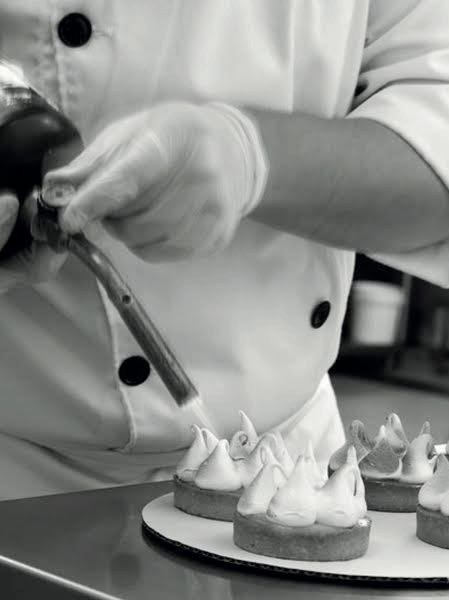
Every piece is finished by hand before it is frozen and sealed.
In House or Outsourced: A Simple Comparison
Staffing. In house: depends on one or two specialist hires. Outsourced: no pastry hire needed.
Consistency. In house: varies with staff and season. Outsourced: same recipe and finish every order.
Kitchen space. In house: needs prep area and equipment. Outsourced: frozen storage only.
Cost control. In house: labor, waste and equipment vary. Outsourced: fixed price per piece.
Range. In house: limited by team skills. Outsourced: a full catalog of sweet and savory.
Peak season. In house: hard to scale up quickly. Outsourced: order more.
Run the Numbers: A Short Checklist
Pizza Today's advice holds for any kitchen. Before deciding, work out:
The true cost of each dessert you make now, including labor, ingredients, waste and equipment.
The hours of kitchen and storage space the pastry program takes.
What happens to your menu if your pastry chef leaves tomorrow.
The cost of a peak season shortfall, such as lost events or last minute substitutions.
A taste test of any outsourced option, run on your own plates, before you commit.
Allergen and Dietary Control
Pizza Today also points to a lesser known benefit: outsourcing allergen free desserts can limit the cross contamination that happens in a busy restaurant kitchen. Curty's USA includes gluten free and dairy free options in the Caterer Collection, and gluten free mixed platters are available, so dietary choices can be part of a standard menu instead of a special request.
How to Choose a Wholesale Pastry Partner
Is the product finished and ready to serve? The less work on site, the less risk on the day.
How is it supplied? Look for stock in the USA and a frozen format, which means shorter lead times and less waste than shipping from overseas for every order.
Are sizes right for your trays and menu? Mini formats suit cocktail hours and dessert tables, and the catalog includes sizes recommended for airline and rail service.
Can you customize? R&D and private label programs let you build a signature dessert.
Can you taste first? Samples show taste, look and fit on your own trays.
Is there proof it works at scale? Curty's USA collaborates with MetLife Stadium on desserts for the Suites and Clubs, a high volume setting with no room for error.
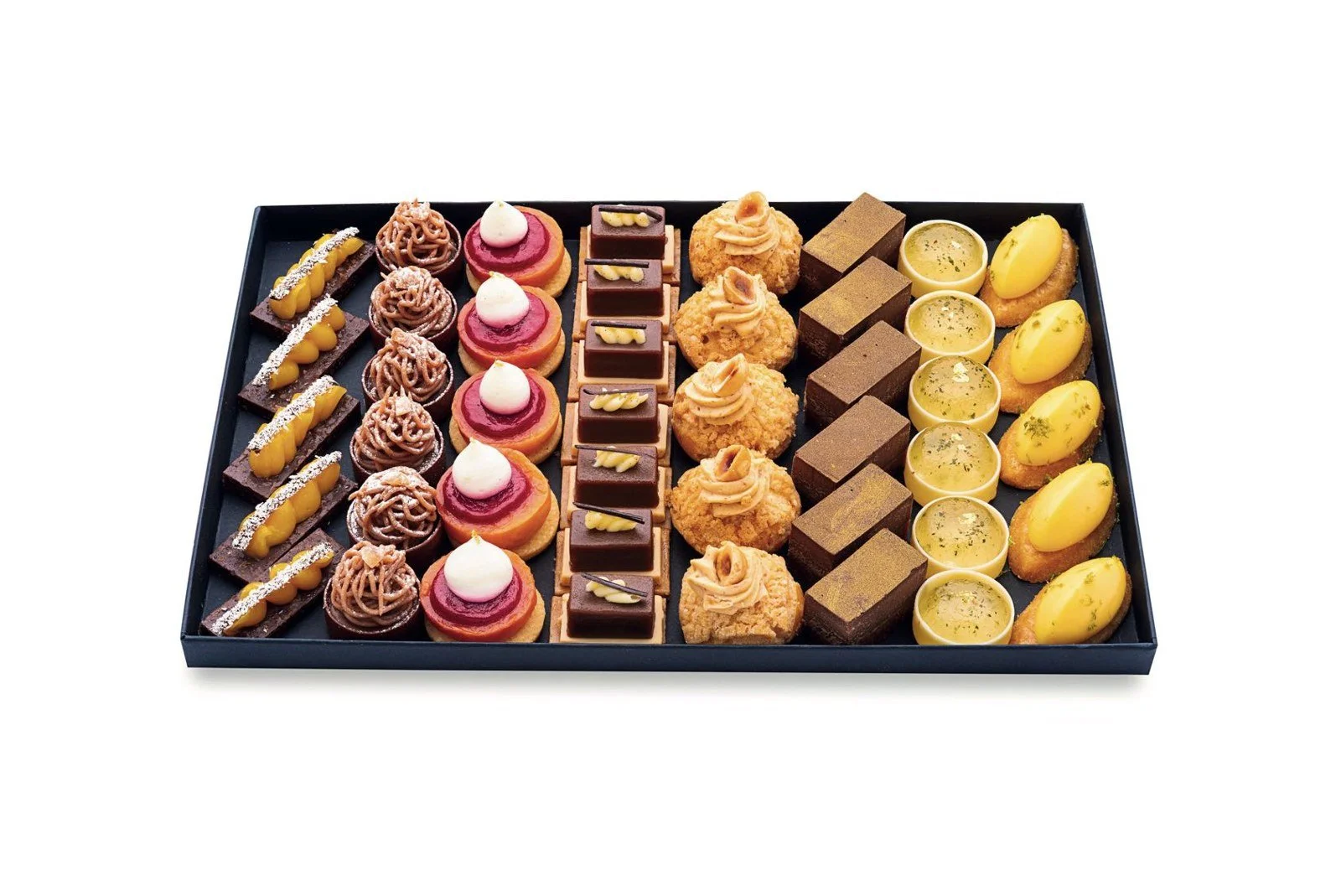
A finished tray from the Caterer Collection, ready to serve straight from the freezer.
Where This Shows Up in Practice
Independent caterers building a dessert offering for the first time. Hotel banquet kitchens covering a packed events calendar. Restaurants and cafés that want a polished dessert list without a pastry team. Venues serving premium suites where consistency matters more than novelty. All of them need restaurant quality food at scale without a full pastry team behind every course.
Outsourcing Pastry FAQ
Will outsourcing lower the quality of my desserts?
Not if the partner is a specialist. Finished, handcrafted pieces can be more consistent than a small team can produce at peak volume. Taste samples first, on your own plates.
What does it cost?
It depends on the items, sizes and volume. Contact us for a wholesale price list.
Can I mix in house and outsourced items?
Yes. Many kitchens keep one or two signature desserts in house and outsource the rest of the range.
Do you offer gluten free and dairy free options?
Yes. The Caterer Collection includes gluten free and dairy free items, and gluten free mixed platters are available.
Can I get custom or private label desserts?
Yes. R&D and private label programs are available for custom flavors, shapes and sizes.
Where are the desserts made?
They are handcrafted in Paris and stocked here in the USA.
Getting Started
If your kitchen is stretched thin on pastry, or you are building a catering menu and do not want to hire around a single specialty, the Curty's USA wholesale program is built for exactly this. Contact us to talk through volume, lead times and which parts of the collection fit your event calendar, and to request samples.